An AI voice agent can answer every call to your online store, 24/7, and handle the routine ones on its own: order status, delivery dates, return policy and COD confirmation, by looking up your real order data during the call. It can take messages, book appointments and log every call with a summary. It can't replace people for complaints, payments, judgment calls or questions your data doesn't cover, so good setups hand those to your team.

How does an AI voice agent work?
There are three parts. A phone number forwards calls to a voice platform (I use Vapi), which turns speech into text, lets an AI model decide what to say, and turns the reply back into a natural voice. When the agent needs facts, it calls a workflow (I use n8n) that reads your store data and returns the answer.
In my demo, a customer calls a sample store and asks about order 1001. The agent, Sara, asks for the order number, and the n8n workflow looks it up while the caller waits a second or two:
Sara: Let me check that for you.
Sara: Your Wireless Earbuds Pro order is shipped with TCS.
Customer: So when will it arrive?
Sara: Your order will arrive tomorrow, September 27th.
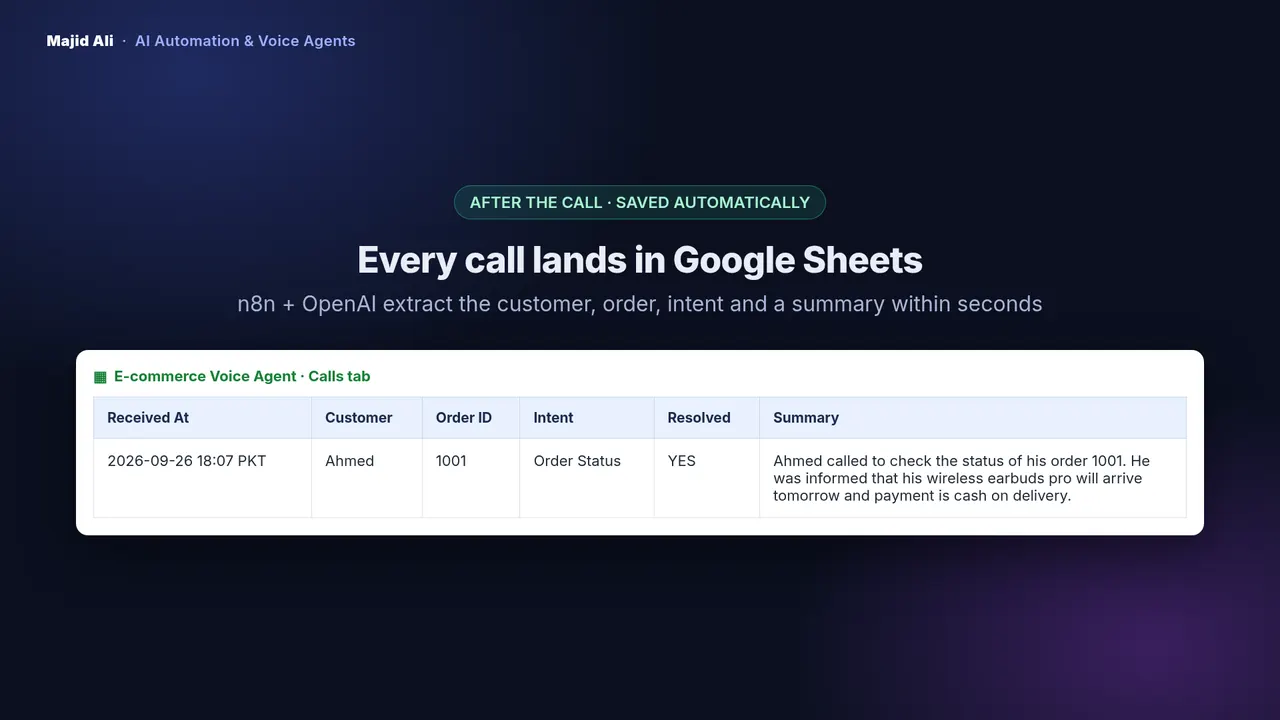
After the call, the same workflow saves the caller's name, order number, intent and a summary to Google Sheets.
AI voice agent call flow
- Customer calls: your store number
- Vapi voice agent: understands the question
- n8n order lookup: Shopify, Woo or Sheets
- Answers live: status, courier, date
- Call logged: summary to Sheets
- Alert if needed: email or WhatsApp
What an AI voice agent can do well
- Answer instantly, any hour. No ringing out while your team packs orders, and no voicemail at 11 PM.
- Order status and delivery questions. With a live connection to Shopify, WooCommerce or a sheet, it gives the real status, courier and expected date.
- Policy questions. Returns, exchanges, delivery areas and opening hours, answered the same way every time.
- COD confirmation. It can confirm a cash-on-delivery order and the amount, inbound or by calling the customer.
- Capture details and book. Name, need, callback number, or an appointment in your calendar.
- Log and summarise every call. Your team reads a two-line summary instead of listening back.
- Alert you to the calls that matter. An angry customer, a wholesale enquiry or a big order gets flagged by email or WhatsApp straight away.
What it can't (or shouldn't) do
- Handle upset customers end to end. It can listen, apologise and take details, but a person should call back.
- Take card payments over the phone. Keep payments in your checkout or a payment link. Don't have an AI read or collect card numbers.
- Answer what your data doesn't cover. Without a lookup tool and clear rules, AI models can sound confident and be wrong. I give agents tools for facts and instructions to say "I don't know, I'll pass this to the team" instead of guessing.
- Work perfectly on every line. Background noise, weak connections and strong accents all affect speech recognition. English works best. Other languages need testing before launch.
- Untangle complex, multi-issue calls. Three orders, a partial refund and a changed address in one call is a job for a person.
- Replace your team. It covers the routine calls and the hours nobody is available, so your team spends time on the calls that need them.
There are also rules to respect. Many places have requirements for outbound calls, such as consent, calling hours and telling people they're speaking to an automated system. I recommend the agent says it's an AI assistant at the start of every call.
What does it cost to run?
Two parts. The build: my packages are $150 (basic AI receptionist), $350 (adds call logging and alerts) and $700 (adds live order lookup or booking, a custom n8n workflow and 14 days of support). The running cost: the phone number and call minutes are billed to your own Vapi or Twilio account, usually a few cents per minute including AI usage. There's no monthly fee to me unless you want ongoing support.
See the full package comparison.
Does your store need one?
A voice agent is worth it if several of these are true:
- Your phone rings while everyone is busy, or after hours, and some calls go unanswered
- Most calls are the same few questions: where is my order, when will it arrive, how do returns work
- A good share of orders are cash on delivery and need confirming
- You'd like a record of every call without anyone writing notes
If your customers rarely call and mostly message, start with WhatsApp automation instead. It's often the bigger win.
How to set one up properly
- List the top questions callers ask and what a good answer looks like.
- Connect the data the agent needs: orders, tracking, policies.
- Write handover rules: when to take a message, alert someone or end politely.
- Test on real calls with different voices, accents and background noise, then adjust.
- Read the call log weekly for the first month and fix the gaps it shows.
Frequently asked questions
Will customers know they're talking to an AI?
They should. I recommend a short disclosure at the start, like “I'm the store's AI assistant”. Natural voices make calls pleasant, but honesty builds trust and helps meet rules that apply in some places.
Can an AI voice agent check Shopify orders?
Yes. During the call it sends the order number to a workflow that reads the order from Shopify, WooCommerce or a Google Sheet, and reads back the status, courier and delivery date. If the order isn't found, it says so.
What happens if the agent doesn't understand the caller?
It asks again, and if it still can't help, it takes the caller's details and alerts your team. Every call is logged, so nothing gets lost.
Can it speak Urdu or Arabic?
English works best. Other languages can be added, but they need testing with real callers before launch, so we discuss your customers' languages in the audit.
Can I hear an example?
Yes. Watch the Sara e-commerce demo, or call the live AI receptionist demo on +1 (930) 216‑3103. It's an AI agent, not a person.

Majid Ali is the founder of Ecom Agent Lab. He builds WhatsApp AI automation, AI voice agents and n8n workflows for e-commerce stores. More about Majid · LinkedIn